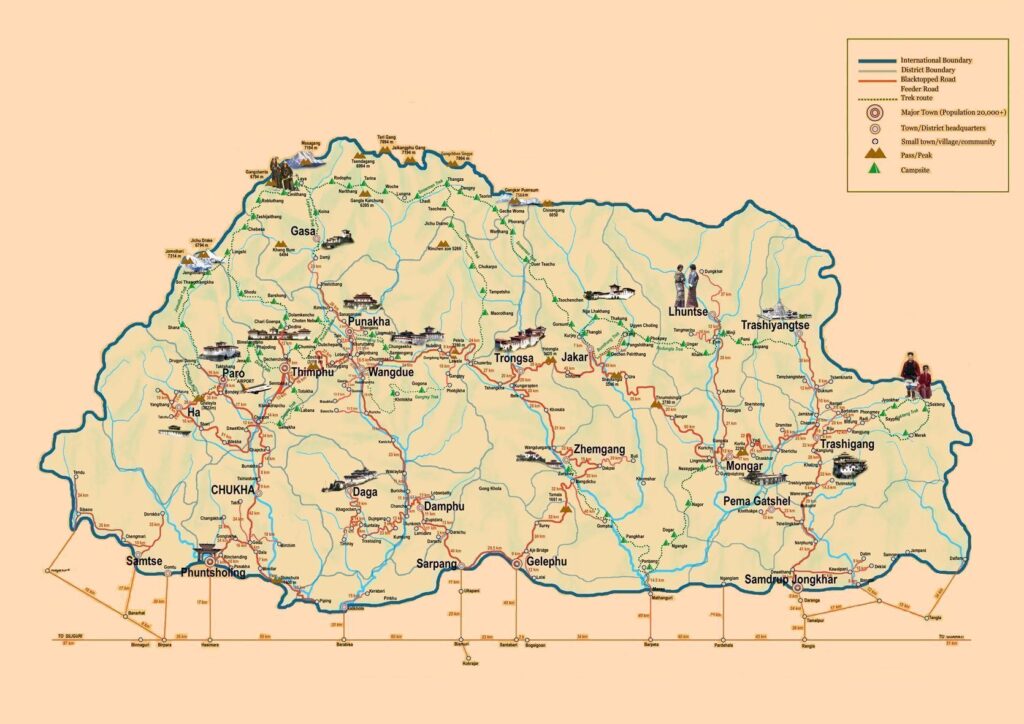
BHUTAN: – A country resting peacefully in the lap of eastern Himalayas is one of those very few places that can probably take you back in time. The unadulterated nature, around 73% of the land drenched in wild greenery, the flag with dragon engraved on it, the rice that is born red, the place which is believed to be haunted by multiple demons and protected by multiple gods, the innocence of the locals that still believe that snowman exists and dragons spit fire, the land that has preserved the rarest of the nomadic tribes and fauna on the list of ‘red-alert’ is what Bhutan is made up of. Not very well known amongst the tourist crowd, Bhutan indeed offers some mystical, magical places to visit for the intrepid traveller.
HOW TO REACH BHUTAN:
BY AIR Paro is the only international operational airport in Bhutan and it is connected by:
- DRUK AIR, the national carrier of Bhutan, which operates regular flights to Indian Cities of New Delhi, Kolkata,Bagdogra & Guwahati. All these cities are conveniently connected with Domestic Indian Carriers from almost all parts of India.
- BHUTAN AIRLINES/ TASHI AIR is a new carrier that has been added for carrying passengers in & out of Bhutan. Presently Bhutan Airlines operates to Indian Cities of New Delhi & Kolkata.
THROUGH INDIA BY AIR, RAIL & SURFACE
Phuentsholing- Bhutan / Jaigoan, West Bengal, (The Indian side city of the border) is conveniently connected by surface and presently the only overland border entries open to Indian & International Tourists. The town of Phuentsholing is located approximately
- 20 Kms from Hasimara Railway Station (HSA), West Bengal, India
- 60 Kms from New Alipuarduar Railway Station (NOQ), West Bengal, India
- 60 Kms from Alipuarduar Railway Station (APDJ), West Bengal, India
- 80 Kms from New Cooch Behar Railway Station (NCB), West Bengal, India
- 165 Kms from New Jalpaiguri Railway Station (NJP), Siliguri, West Bengal, India
- 170 Kms from the Bagdogra Airport (IXB), Siliguri, West Bengal, India
SIGHTSEEING PLACES IN BHUTAN:
THIMPHU: – Thimphu is the capital of Bhutan and the largest town in Bhutan. It lies at an altitude of 2400 metres . All Government headquarters and centre for trade are located here. The following are the places of tourist attraction in Thimphu:
1. Trashichho Dzong: Meaning “fortress of the glorious religion” was initially erected in 1641 and rebuilt by King Jigme Dorji Wangchuck in the 1960s. It is one of the largest dzongs in Bhutan. The Dzong houses the throne room and office of His Majesty and is the seat of government and religious affairs in the kingdom. The northern portion of the dzong has the summer residence of the central monastic body and His Holiness the Je Khenpo (chief abot). It is open to visitors only during the Thimphu Tsechu (held in autumn) and during winter when the monk body moves to Punakha.
2. National Memorial Chorten: This monument was built in 1974 in the memory of the late King Jigme Dorji Wangchuck. It was originally the idea of Bhutan’s third king, H.M. Jigme Dorji Wangchuck to erect a monument for world peace and prosperity but could not be done due to his untimely death. So after his death, it was built to in his memory and to serve as a monument for world peace.
3. Simtokha Dzong: Built in 1627, it is the oldest Dzong in the country. The most noteworthy artistic feature of this dzong is the series of over 300 finely worked slate carvings behind the prayer wheels in the courtyard which are centuries old. The paintings inside this dzong are believed to be some of the oldest and the most beautiful in the country.
4. National Library: The National Library was established in the late 1960s and it houses an extensive collection of Buddhist literature mostly in block-printed format and some works are several hundred years old. There is also a small collection of books in English on the ground floor mainly on Buddhism, Bhutan, the Himalayan region and neighboring countries.
5. Institute for Zorig Chusum: Commonly known as the Painting School is an institute established primarily to preserve and promote Bhutan’s unique artistic tradition which played a vital role in moulding its distinct heritage. The Institute offers a six-year course on the 13 traditional arts and crafts of Bhutan and on a visit one can see students learning the various skills taught at the school.
6. National Institute of Traditional Medicine: The Institute was established in 1967 as a center for indigenous medicines and practice. In olden times, people primarily relied on the indigenous medicines to cure their illness. The Institute also serves as a training school for traditional medicine practitioners. The complex is closed to visitors due to considerations of hygiene, but one can still walk around and view it from the outside.
7. Changangkha Lhakhang: This temple is one of the oldest in the Thimphu and was built in the 12th century by Nyima the son of Phajo Drugom, the founder of Drukpa school of Buddhism in Bhutan. The temple is highly revered by the Bhutanese especially because new born babies are normally brought here to seek blessings from the deity.
8. Dechen-phodrang : This is the site of Thimphu’s original Tashicho Dzong until 1772 and was named “Do Ngon Dzong” meaning the fortress of the Blue Stone. Today, it houses the monastic school where novices are taught before they go for higher Buddhist studies. The monastery contains paintings of the 12th century which are being restored for preservation.
9. Wangdi-tse Monastery: This monastery is located further uphill towards the west of Dechenphodrang. It was founded in 1750 by 8th Desi Tenzin Rabgye and houses some ancient stupas made of sandal wood. One can take the natural trail walk from the BBS tower at the hill overlooking Thimphu valley to this monastery.
10. Folk Heritage Museum & the Textile Museum: These museums, both of which opened in 2001, provide fascinating insights into Bhutanese material culture and way of life and is a ‘must see’ when in Thimphu.
11. Buddha Dordenma: The quaint town of Thimphu is home to a 51 metres tall gold-plated statue of Buddha Dordenma, which is entirely made up of steel. The night sees this statue beautifully illuminated and makes it even better sight to behold. The statue houses around 125,000 spectacular smaller Buddha statues made of bronze and plated in gold, each of which looks like the Dordenma itself.Built amidst the ruins of Kuensel Phodrang , it marks your entry in Thimphu. The golden gilded statue is a marvel to behold, especially at nights, when it shines against the dark sky. The base of the statue, which is 3 storeys tall, is a meditation hall. It is one of the largest Buddha Stupas in the world.
12. Simply Bhutan Musuem: Flaunting the rich Bhutanese culture to the world, Simply Bhutan Museum displays the impressive traditions and gives a glimpse of the country’s history. A one-of-its kind “living” museum, visitors get to enjoy the Bhutanese songs, folk dances and finger-licious cuisine. One can actually live the country’s culture by trying on traditional clothes and archery.
13. BBS Tower : Bhutan Broadcasting Service Tower or BBS Tower is at an elevation of 2,865 metres which offers an exquisite view of the whole town of Thimphu. Also known as Sangaygang Viewpoint, this is very popular among visitors because of the beautiful panorama of the lush valleys that it provides. The route to the Wangditse Goemba starting from this point is a hikers and mountain bikers favourite trail. The Tower is a 10 mins drive from Motithang Takin Preserve -It has many photogenic spots, but make sure you don’t click pictures of the telecommunication installations.
14. SAARC Building: Proudly housing the national assembly, SAARC Building in Thimphu was built in the 1990s to hold SAARC conferences and meetings. It is located near Trashi Chho Dzong across Wang Chhu. An architecture marvel, the building is colourful and vibrant. Since it is an important government site, entry is not allowed due to security reasons. But the building is a good view from outside.
15. Weekend Market: Offering endless opportunities to peek into the culture of the country and to interact with locals, the Weekend Market of Thimphu is the city’s star on Saturdays and Sundays. Located at the north of Changlimithang Stadium, at the west bank of the Wang Chhu, the market is bustling with traders and customers, it looks colourful and vivid and it is an ideal place to buy souvenirs. Everything, from vegetables to accessories to postal stamps, is sold here at unbelievably low prices.
In Punakha:– Punakha is located at an alleviation of 1250m and played a very important role in history. It had been the capital for over 300 years. The places to visit in Punakha are:
1. Douchala Pass: Dochula Pass is a breath-taking mountain pass, in commemoration of Bhutanese soldiers who passed away in military operations for the country. Along the Dochula Pass, there are 108 memorial chortens (also known as stupas) called the ‘Druk Wangyal Chortens’ for each soldier’s life lost in the war. The hills are also decorated with colourful religious flags in five colours to represent the natural elements: blue for the sky, red for fire, green for water, white for clouds, and yellow for earth. To the local Buddhist people, these flags are symbols of veneration and the inscriptions of prayers on each flag signals peace and prosperity for Bhutan.
2. Punakha Dzong: Punakha Dzong is the second oldest and second largest dzong in the country. It was here that the first national assembly was held in 1953 and it remained the seat of the Government of Bhutan until 1955. Not only does this dzong boast of Bhutanese architectural marvel, but it also remains culturally important for housing sacred relics of the Kagyu school of Tibetan Buddhism and the sacred remains of Ngawang Namgyal, the Tibetan Buddhist lama and unifier of the country of Bhutan.Located at the intersection of the Pho Chuu and Mo Chuu rivers in the Punakha Valley, Punakha Dzong was constructed in 1637 by Ngawang Namgyal. It is over 180 metres (590 feet) long and 72 metres (236 feet) wide having six towers surrounding it and the only way to reach the dzong is by crossing the bazam (bridge). It was built within a year of construction and interestingly, it was built without the use of any nails. Punakha Dzong is listed in Bhutan’s tentative list for UNESCO inclusion for its cultural, religious, and architectural significance in the region. Moreover, Punakha Dzong’s altitude of 1,200 metres provides relief while adjusting to altitudes in the region, making this an ideal location to begin a journey in Bhutan.
3. Chimi Lhakhang: Located an hour outside Punakha village, Chimi Lhakhang, (also known as Chime Lhakhang) is a Buddhist monastery best known for its worship of the phallus. It stands on a round hillock said to resemble breasts and is decorated with phallic symbols all along its walls. It was built in honour of Drukpa Kunley, the “Divine Madman” who preaches Buddhism through humour and sexual tones.
4. Punakha Suspension Bridge: The second-longest suspension bridge in Bhutan, Punakha Suspension Bridge is perched over the Mo Chhu and Po Chhu (river) and is about 160-180 meters in length. It is one of the oldest suspension bridges in the world that connects Punakha Dzongkhag to the rest of the valley. Believed to be built by Thangtong Gyalpo, the bridge has undergone several years of renovation. It has an integral part in the architectural history of Bhutan as it was built to connect the villages of Samdingkha and Wangkha by the kings of Wangchuk. The bridge is beautifully draped with prayer flags and makes a perfect spot for bird watching and photography. Although it is built sturdily, it shakes when winds blow strongly, and that is when the thrill is at its zenith.
5. Khamsum Yulley Namgyal Chorten: Located after a hike of 45 minutes from a small hill having a beautiful prayer wheel, Khansum Yulley Namgyal Chorten is a spectacular site to visit because of the beautiful view of the surroundings that it offers. It has a very rich history as to why it was built and it is a pleasure to hear it from one of the local guides. It is adorned with beautiful paintings of Sakyamuni, which makes this chorten a must watch.
Wangduephodrang:- Located south of Punakha is Wangduephodrang and lies at an altitude of 1350m. The higher reaches of the Wangduephodrang valley provide rich pasture land for cattle and this valley is famous for its fine bamboo work, stone carvings, and slates. Places of interests in Wangdue are:
1. Wangduephodrang Dzong: It is the highlight of the last town of western Bhutan. It was built in 1638 and is perched on a spur above the confluence of the Punakha Chu and Dang Chu rivers. It played an important role in our history because the location of this Dzong commends an impressive view over both north-south and east-west highway. The Dzongpon (governor of the region) was the third most powerful in Bhutanese history after the Tongs and Paro Penlop.
2. Gangtey Gompa / Phobjikha (3,000m/9,845ft): Another highlight of Wangdue is the beautiful Phobjikha Valley or “the valley of black necked cranes”. This valley is the winter home of black necked cranes that migrate from Tibet. This valley is one of the most beautiful and scenic ones in Bhutan. On the slope overlooking the valley is the Gangtey monastery built in 17th century and is one of the oldest and biggest monasteries of the Nyingma (red hat sect) school of Buddhism.
Paro:- It lies in Western Bhutan at an elevation of 2280 m. As the only airport is located here, it is the gateway into this mystical kingdom. The main tourist attractions in Paro are:
1. Rinpung Dzong: or “the fortress of the heap of jewels” was built in 1646 by Shabdrung Ngawang Namgyal to defend the Paro valley from Tibetan invasion and presently it serves as central monastic and administrative seat of the district of Paro. It is one of Bhutan’s most impressive and finest examples of Bhutanese architecture. It is different for other Dzongs in Bhutan as it is in a square and the “utse” (central tower) is surrounded by the outer structure. The dzong houses one of the most sacred “Thongdrol” (meaning religious banner) about 20 sq. metres and is displayed only once a year during the Paro Tshechu (annual festival). The third king of Bhutan was crowned in this dzong.
2. Nya-mey Zam: or “the bridge with no fish” is the bridge that connects Paro town to the dzong. It is one of the finest specimens in Bhutan and locals believe that if one sees a fish in the river, it is an ill omen. The earlier bridge which could be folded during war was washed away by flood in 1969.
3. Ta Dzong: Strategically located on a hill above the dzong and built in 1649 is the Ta Dzong. “Ta”means to see/watch and “dzong” means fortress. This monument served as a watch tower to the Paro Dzong. There is said to be an underground tunnel that leads to the water supply below. The structure was converted to the National Musuem in 1968. Ta Dzong holds a fascinating collection of art, relics, religious thangkha paintings, exquisite postage stamps, coins and handicrafts and a small natural history collection.
4. Dungtse Lhankhang: This temple was built by a famous Tibetan saint popularly known as Changzampa or the iron bridge builder in 1421. It is the only temple of this kind in Bhutan. It is in the form of a stupa and it contains some of the rarest and unique frescoes paintings in the region. The paintings are unique also because they depict the progressive stages of tantric Buddhist philosophy as well as the most important deities and figures of Drukpa Kagyu School of Buddhism.
5. Drukgyel Dzong: “fortress of the victorious Drukpas” was built in 1649 to celebrate Bhutanese victory over the Tibetan invasions. What stands a mere tourist spot today was once western Bhutan’s most strategic fort from which many Tibetan invasions were repulsed. Under the leadership of Zhabdrung, Bhutanese fought 12 battles with the Tibetans in different places with one being in this particular place. It was destroyed by fire in 1951, and the towering outer walls and central tower still remains an imposing sight. On a clear day, there is a splendid view of Mt. Chomolhari from the approach road to this place.
6. Kyichu Lhakhang: Consists of twin temples and the older one is one of the 108 temples built by King Songtsen Gampo of Tibet in 659 AD. This temple is deeply venerated for its antiquity and the role it plays in Bhutan History. The construction of this temple and Jampa Lhakhang in Bumthang marked Bhutan for the first time on Buddhist map. The temple contains one of the most sacred statues of the country – the jowo which is the image of Buddha at 8years and is similar to the one which is present in the Jokhang temple in the Potola Palace in Lhasa, Tibet.
7. Kila Gompa: It is a nunnery about an hour’s walk from Chele-la, down a path through pine forest. The gompa is nestled in a craggy patch of rock on the mountainside below Chele-la pass. Buddhist nuns spend their days in religious studies, prayer and meditation.
8. Druk Choeding: This is an ancient temple located right in Paro town. It was built in 1525 by Ngawang Chhogyel, one of the prince-abbots of Ralung in Tibet, and an ancestor of the Shabdrung, Ngawang Namgyal
9. Paro Airport Bird’s Eye Viewpoint: Paro Airport Bird’s Eye Viewpoint offers an exquisite view of the entire city. With the Paro International airport being in the top ten stunning airports in the world, you can imagine what’s in store for you. Amidst the mountains, the sight is so colourful and vivid that one remains awe-struck by the grandeur of the city.
10. Tachog Lhakhang Bridge: Popularly known as the Iron Chain Bridge, the Tachogang Lhakhang Bridge crosses the Paro Chhu to the Dzong. This 600-year-old bridge was built by Thangtong Gyalpo in the late 1300s, who is said to have built 108 bridges all over Tibet and Bhutan. Made of wood and Iron, this is the first bridge to have ever been built in Bhutan. Tachogang Lhakhang Bridge greets its guests with a fantastic view of the surroundings.
11. Chele La Pass: Located at approximately 13,000 feet between the valley of Paro and Haa, Chele La Pass is the highest motorable road pass in Bhutan. The pass is famous for the stunning Himalayan views it offers, especially Mt. Jhomolari which is Bhutan’s most sacred peak at 22,000 feet, Tsherimgang mountains, Jichu Drake as well as views of both the valleys, Paro and Haa. Just a two-hour drive from the valley floor in Paro, you will reach Chele La Pass, covered in untouched forests, home to thriving flora and fauna. The surrounding area of this pass has several ancient trails, perfect for hikers. The slopes of the mountains around are covered in White Poppy, which cannot be found anywhere else in the world. The drive to Chele La Pass is through dense spruce and larch forests where you can see many sightings such as yaks grazing, frozen river, waterfalls, rhododendron forest and roadside springs.
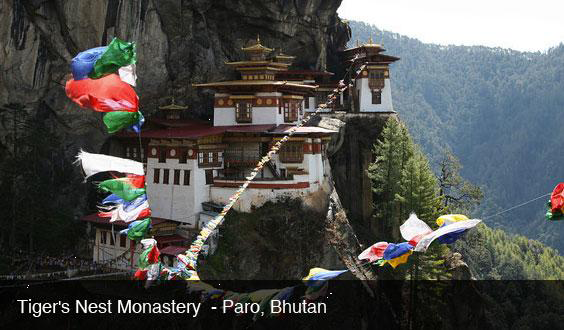
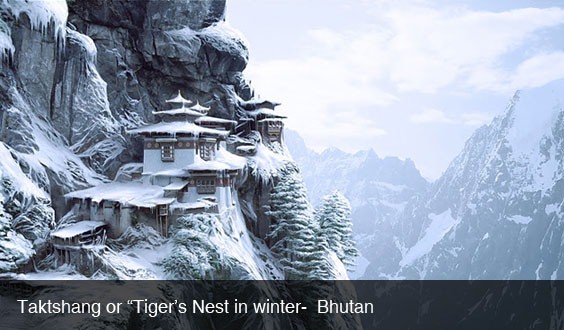
12. Taktshang: or “Tiger’s Nest”: Tiger’s Nest” is one of the most famous places to visit in Bhutan and one of the holiest sites in Bhutan. It is perched on a steep granite cliff at 2950 metres overlooking northern paro valley. The place is especially venerated because of its association with Guru Rimpoche and is believed that more merit is gained if we meditate even for a minute in Tasktshang than many months in other places
13. Ugyen Pelri Palace: Built in the early 1900s, the Ugyen Pelri Palace is an excellent display of Bhutanese architecture at its finest. It was modelled after the Zangto Pelri which was known as Guru Rinpoche’s paradise. It currently serves as the residence of the queen mother of Bhutan. The palace is closed to the public. It is situated next to the iconic Five Chortens of Paro, may be viewed in its entirety from the Paro Dzong.
Bumthang: This broad valley at an altitude of 2700m contains early historic and legendary traditions of Bhutan. This lovely valley is the religious heartland of the nation and home to some of its oldest Buddhist temples and monasteries. Tales of Guru Padmasambhava and the tertons (“religious treasure-discoverers”) still linger in this sacred region. The main tourist attractions in Bumthang are
1. Jakar Dzong: Constructed in 1549 by the great grandfather of the first Shabdrung, the dzong was initially built as a monastery. It was upgraded in 1646 after Zhabdrung firmly established his power. Jakar Dzong is now used as the administrative center for Bumthang valley, and also houses the regional monk body.
2. Jambey Lhakhang: This temple was built in the 7th century by the Tibetan king, Songtsen Gampo. It is one of 108 monasteries which he built to subdue evil spirits in the Himalayan region. Its present architectural appearance dates from the early 20th century. This temple is considered one of the most sacred ones in Bhutan and the main altar has the jowo which is the image of Buddha at 8years and is similar to the one which is present in the Jokhang temple in the Potola Palace in Lhasa, Tibet.
3. Kurje: Located further along the valley, Kurje Lhakhang comprises three temples. The one on the right was built in 1652 against the rock face where Guru Padmasambhava meditated in the 8th century. This place considered to be the most holy and also historically significant as Buddhism in Bhutan started from here.Three to five minute up from the gate is the “Drup-chu” or holy water and is considered the holiest water in Bhutan.
4. Tamshing : Located across the river from Kurje Lhakhang, is the temple founded in 1501 by Terton Pema Lingpa the famous treasure discoverer. There are very old religious paintings around the inner walls of the temple. There is also an iron jacket made by the great tertoen himself and at your visit you would probably come across pilgrims circulating the main altar with the jacket as it is believed to wash away sins.
5. Koenchog Sum Lhakhang: located few minutes from Tamshing is this temple and it dates back to 7th century. This temple is famous for its giant bell which bears an antique inscription. Legends say that the bell was stolen from a Tibetan royal family and transported to Bhutan. Tibetan armies were sent to fetch the bell back but because of its immense weight, the soldiers could not carry it and dropped it that made the crack which is still visible. The bell was taken to the national museum in Paro, but misfortune fell on the locals and the bell was returned to the temple. Besides the bell, the temple also houses statues of the three past, present and future Buddhas from which the temple derives its name- “Koenchog” means divine / buddha and “sum” means three.
6. Jakar Lhakhang: It is one of the oldest temples in Bhutan. Ashi Peldon, the lineage of Jakar built this in the 14th Century as her private residence but was later converted into a temple as legends say that Ashi Peldon found the main statue of the temple in the ground floor. This lhakhang houses some very fine paintings of the Goddess of Victory and Long Life.
7. Wangdue Choling: Palace: Built in 1658 by Tronsga Penlop Jigme Namgyel, the founder of our present monarchs, this palace is one of the oldest palaces in Bhutan. It was the seat of Bhutan’s reining Wangchuk Dynasty and one of the finest examples of domestic architecture in the Country.
8. Mebar-tsho: or “The Burning Lake” is one of the most sacred pilgrim sites in Bhutan. It is a narrow gorge in the Tang River and is believed to be the place where the saint Tertoen (treasure discoverer) discovered religious treasures hidden by Guru Padmasambhava. There is great legend of how the saint discovered the treasures.
ALTITUDE:
| PLACES | ALTITUDE | |
| IN METERS | IN FEET | |
| PARO | 2195 Mts. | 7200 Feet |
| THIMPU | 2320 Mts. | 7600 Feet |
| PUNAKHA | 1287 Mts. | 4220 Feet |
| WANGDI | 1350 Mts. | 4430 Feet |
| TRONGSA | 2317 Mts. | 7600 Feet |
| BUMTHANG | 2600 – 4000 Mts. | 8530 – 13125 Feet |
DISTANCES AND TRAVEL TIME WITHIN & TO BHUTAN:
| FROM | TO | DISTANCE | HRS (APPROX) | |
| Phuntsholing | Paro | 145 km | 5-6-hours | |
| Phuntsholing | Thimphu | 145 km | 5-6-hours | |
| Paro | Thimphu | 65 km | 1-1.5 hour | |
| Paro | Haa | 65 km | 1.5-2 hours | |
| Thimphu | Haa | 115 km | 3-4 hours | |
| Thimphu | Wangduephodrang / Punakha | 70/80 km | 2-3 hours | |
| Punakha | Gangtey (Phobjikha) | 78 km | 2-3 hours | |
| Punakha | Bumthang | 212 km | 7-8 hours | |
| Bumthang | Gangtey (Phobjikha) | 188 km | 5-6 hours | |
| Gangtey(Phobjikha) | Trongsa | 120 km | 4-5 hours | |
| Trongsa | Wangduephodrang | 129 km | 4-5 hours | |
| Trongsa | Bumthang | 68 km | 2-3 hours |
Political MAP: